What is non-employee compensation?

Non-employee
Non-employee, or statutory non-employee, is generally used as part of the phrase “non-employee compensation.” It refers to any individuals who are not official employees of the employer but still contribute to the business with their labor. This distinction is essential because non-employees are not entitled to the same benefits or subject to the same tax regulations as employees; for example, data from July 2023 shows contingent workers were significantly less likely to have employer-provided health insurance than their noncontingent counterparts (19.9% vs 51.2%).
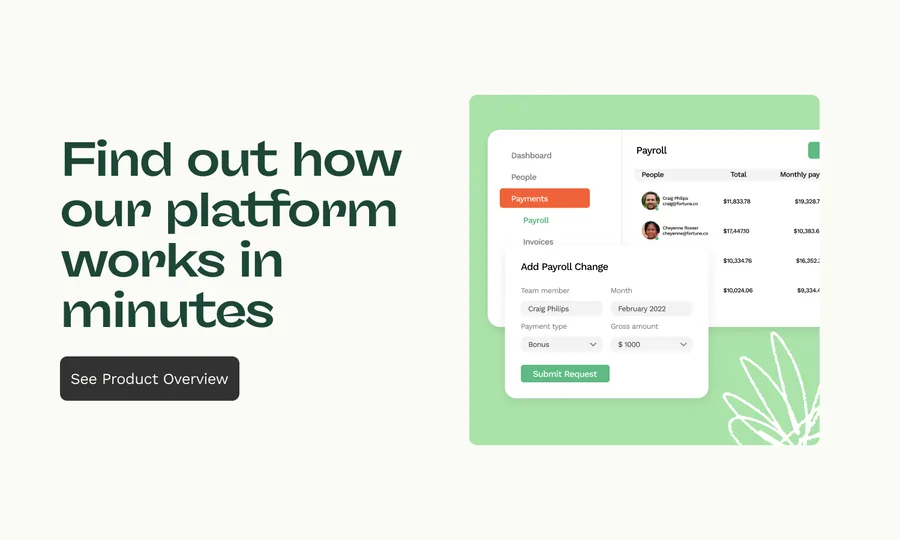
Interested in Oyster but want more information about how the platform works? This product overview should help.
An independent contractor is the most common example of a non-employee, with the U.S. Bureau of Labor Statistics reporting there were 11.9 million people working as independent contractors in July 2023. Other examples include vendors, consultants, and freelancers.
What is non-employee compensation?
So, what exactly is non-employee compensation? It's money you pay to contractors, freelancers, and consultants for their services—think commissions, project fees, and service payments. The key difference from regular employee pay is that it doesn't include benefits like health insurance or retirement plans.
Example 1
You hire a freelance video editor to edit a series of promotional videos for your company. The freelancer will take your footage and assemble several finished videos for your company. For these services, the freelancer charges $5,000 upfront and an additional $5,000 at the end of the project.
If you're in the US, since you're paying this freelancer more than $600 a year, you must complete a 1099-NEC form to report the payments.
Example 2
Rather than hiring an in-house accountant, your company contracts your bookkeeping to a local accountant. The accountant charges $4,000 per month, invoiced at the start of every month, for these services. You're only interested in three months of bookkeeping during tax season, so you'll pay the accountant $12,000. Your business reports this $12,000 payment to the relevant tax authority.
What Is Form 1099-NEC?
If your business hires non-employees, you're responsible for reporting any payments you make to those workers to the IRS. The appropriate form for reporting non-employee compensation is Form 1099-NEC.
How to report non-employee compensation with IRS Form 1099-NEC?
Here's what you need to know about filing requirements:
$600 threshold: File Form 1099-NEC for any non-employee you paid $600 or more during the tax year
No tax withholding: Unlike employees, you generally don't withhold taxes from non-employee payments, though the IRS requires you to withhold 24% for backup withholding if the contractor hasn't provided a valid taxpayer ID number.
Your only responsibility: Report the compensation to the IRS—the contractor handles their own tax payments
Filing deadlines and requirements
When's the deadline? January 31 of the year after you made the payments. You'll need to send copies to both the IRS and the contractor by this date, and be aware that as of 2024, regulations have lowered the e-file threshold to 10 or more information returns, requiring most businesses to file electronically.
Missing the deadline isn't cheap—penalties range from $50 to $280 per form depending on how late you file. Mark your calendar and file on time to avoid the headache.
How to classify a worker: Employee vs. non-employee
An employer's relationship with employees differs significantly from those between employers and non-employees. To follow labor laws and tax regulations, you must correctly classify each worker you hire, as research suggests miscoding is a significant issue that nearly doubles the share of workers who are actually independent contractors to about 15% of the workforce. The IRS has provided three factors to consider that will help determine whether a worker is an employee or non-employee.
Financial control
Unlike employees, non-employees can set their own rates and terms for payment. Employees typically receive an hourly wage or salary determined by their employers' payment structures. Non-employees have more freedom to dictate the financial terms of the agreement, such as charging per hour, per project, or with a monthly retainer fee. They can also select the payment method that works best for them.
Behavioral control
Behavioral control comes down to who decides how work gets done:
Employees: You control when, where, and how they work, including tools and equipment
Non-employees: They choose their own schedule and methods as long as they deliver results
The key difference? You manage employees' daily work, but with contractors, you only care about the final deliverable.
Relationship to employer
Employees have a closer, more integral relationship with the employer than non-employees. While employers generally hire employees indefinitely, non-employees usually work on a more short-term, goal-focused basis.
If a worker has a long-term relationship with the employer and their services are an integral part of the employer's business, that suggests the worker should be classified as an employee, not an independent contractor or consultant.
Managing non-employee compensation effectively
Paying contractors and freelancers involves more than just sending an invoice. It requires careful attention to worker classification, tax reporting, and local compliance to avoid costly penalties. Getting it wrong can lead to misclassification fines and tax audits, creating significant risk for your business.
A global employment platform simplifies this process. Oyster helps you manage global contractors compliantly from one dashboard—from creating locally compliant contracts to ensuring on-time payments in over 120 currencies. By centralizing your contractor management, you reduce administrative work and mitigate compliance risks, allowing you to focus on building your global team. Ready to simplify how you pay non-employees? Start hiring globally.
 FAQs
FAQs
What is the threshold for non-employee compensation?
You must file Form 1099-NEC for any non-employee you paid $600 or more during the tax year. This applies only to business payments, not personal ones.
Is non-employee compensation considered business income?
Yes, contractors must report it as self-employment income on Schedule C and pay self-employment taxes on it.
When do you have to file Form 1099-NEC?
January 31 of the year after you made the payments. So payments made in 2024 must be filed by January 31, 2025.
.webp)
About Oyster
Oyster enables hiring anywhere in the world—with reliable, compliant payroll, and great local benefits and perks.

Related Resources
.avif)
.avif)


.avif)
